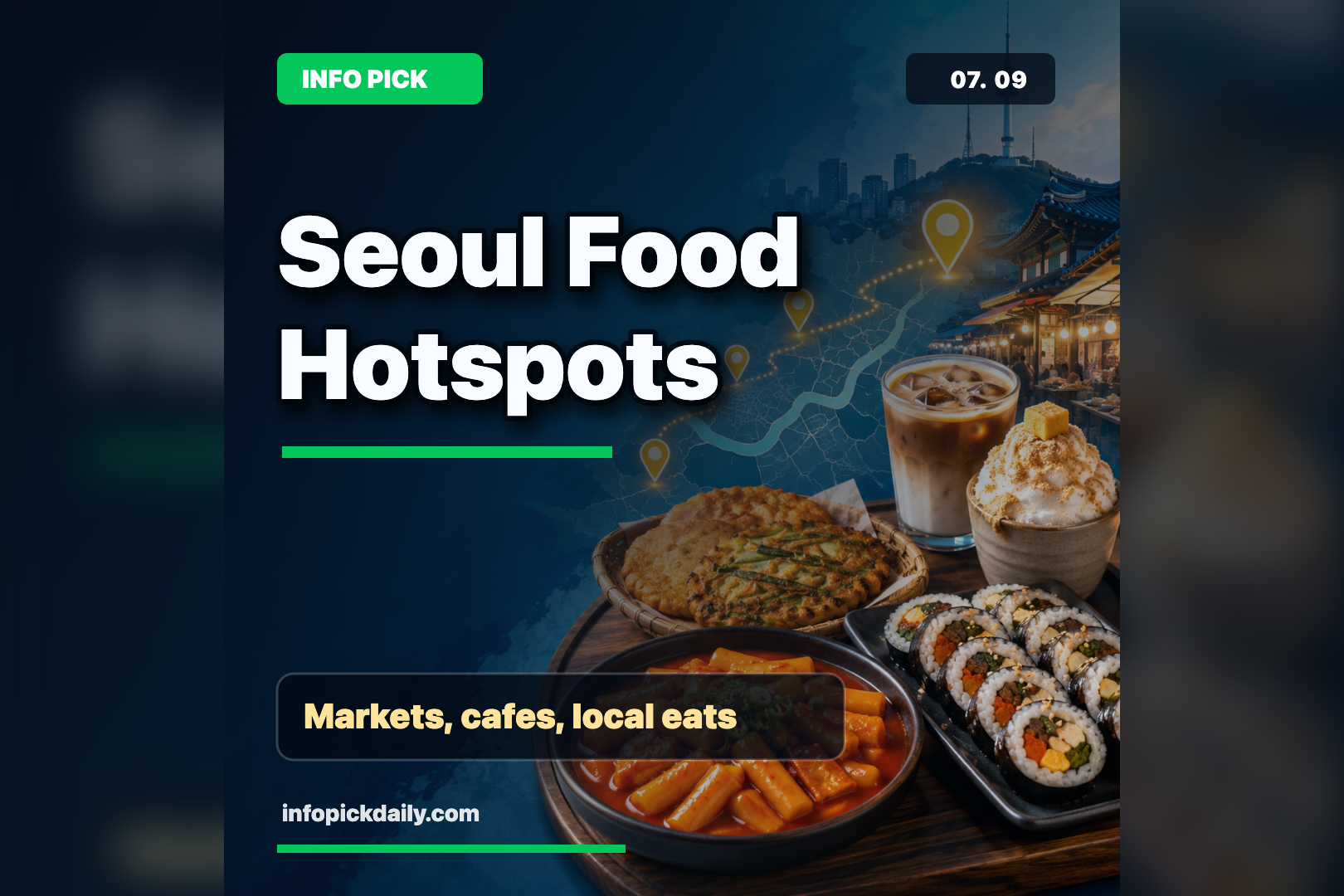
The quickest answer is this: for a first Seoul food trip, eat traditional street food at Gwangjang Market, snack with locals at Mangwon Market, try kalguksu or galchi-jorim at Namdaemun, use Myeongdong for convenient night snacks, then save Seongsu, Ikseon-dong, Yeonnam, and Hongdae for cafes, pop-ups, dessert, and nightlife. Do not build your whole trip from one viral video. Use creator posts for inspiration, then verify hours, break times, prices, and route details on Naver Map, KakaoMap, Visit Seoul, VISITKOREA, or the restaurant’s own channel before you go.
Key Takeaways
Seoul food is not one district. It is a moving map of markets, alleys, subway exits, cafes, queues, and tiny shops that may close early when they sell out.
- Best classic market is Gwangjang Market for bindaetteok, mayak gimbap, tteokbokki, eomuk, mandu, and yukhoe if you eat raw beef.
- Best local snack market is Mangwon Market for dakgangjeong, croquettes, fried peppers, bunsik snacks, and nearby Mangridan-gil cafes.
- Best central budget meal is Namdaemun Market, especially Kalguksu Alley and Galchi-jorim Alley near Hoehyeon Station.
- Best easy first-night stop is Myeongdong because it is central, bright, simple to navigate, and packed with street stalls, but it can be pricier and more tourist-heavy.
- Best hotplace cafe areas are Seongsu for pop-ups and warehouse-style cafes, Ikseon-dong for hanok cafes, and Yeonnam or Hongdae for young local energy.
- Best practical rule is to carry a card plus some cash. Many shops accept cards, but traditional markets, small carts, and old-school stalls may still be smoother with cash.
- Best support number is 1330 Korea Travel Helpline for tourism help, interpretation, and complaint guidance.
What This Guide Covers
This is written for foreign visitors, exchange students, digital nomads, and first-time Seoul travelers who want more than a pretty food reel.
- Where to go first if you have only one night in Seoul.
- Which markets are best for street food, local meals, and photos.
- Which restaurants are easier for foreigners and what dishes to order.
- How to use local apps, payment cards, transit cards, and translation tools.
- How to check blogs, influencers, and Korean review posts without falling into tourist traps.
- What to do about spice, allergies, halal, vegan, solo dining, refunds, and customer support.
The Quick Answer
A good Seoul food day should have one market, one proper sit-down meal, one cafe or dessert stop, and one neighborhood walk.
For a first visit, start at Gwangjang Market around late morning or early afternoon, then walk toward Jongno, Ikseon-dong, or Cheonggyecheon. Eat bindaetteok, mayak gimbap, mandu, and tteokbokki lightly. Do not fill up at the first stall. Later, go to Ikseon-dong for a hanok cafe or dessert. For dinner, choose one sit-down restaurant such as samgyetang, gomtang, kalguksu, Korean BBQ, or a MICHELIN Bib Gourmand pick. End with Seongsu, Hongdae, Euljiro, or Myeongdong depending on your hotel location and energy level.
A realistic daily food budget for a curious visitor can range from about ₩25,000 to ₩60,000 per person if you mix markets, casual restaurants, coffee, and snacks. A fine dining meal, premium BBQ, crab, beef, or a tasting menu can push the day much higher. Prices move quickly in Seoul, so use menus posted at the shop and recent Naver reviews as the final check.
| Traveler type | Best first area | What to eat | Why it works |
|---|---|---|---|
| First-time visitor | Gwangjang Market | Bindaetteok, gimbap, mandu, tteokbokki | Classic, central, easy to combine with palaces and Jongno |
| Budget traveler | Mangwon Market | Dakgangjeong, croquettes, bunsik snacks | Local feel, good value, close to Mangridan-gil and Hongdae |
| Family or spice-cautious traveler | Namdaemun | Kalguksu, bori-bap, galchi-jorim if okay with spice | Real meals, central location, old-school Seoul atmosphere |
| Cafe hunter | Seongsu or Yeonnam | Specialty coffee, pies, bakeries, pop-up desserts | Trendy interiors, photos, brand pop-ups, easy cafe hopping |
| Night snack seeker | Myeongdong | Skewers, egg bread, hotteok, tornado potato | Convenient, bright, simple for first-night exploring |
Seoul Food Map
Think in neighborhoods, not single restaurants. Seoul rewards people who plan by subway station and food mood.
Jongno and Gwangjang are best for old Seoul market energy. Namdaemun and Myeongdong are best when you want food near hotels, shopping, and airport transport. Mangwon, Hapjeong, Hongdae, and Yeonnam are better for younger local energy, casual meals, dessert cafes, and late walks. Seongsu is the pop-up, cafe, design, and brand-culture zone. Ikseon-dong is compact, photogenic, and easy to pair with Insadong, Jongno 3-ga, and palaces. Itaewon is the safest first area for halal, vegan, vegetarian, international, and late-night mixed groups.
Foreign visitors often over-pack Myeongdong, Gwangjang, Gangnam, and Hongdae into one day. It looks close on a map; it feels chaotic on your feet. Pick one old-market route and one modern hotplace route per day. Your stomach and your phone battery will both thank you.
Market Routes
Markets are the best way to taste many Korean foods fast, but each market has a different personality.
Gwangjang Market
Use Gwangjang Market for Seoul’s traditional street food core. Visit Seoul highlights snacks such as addictive gimbap and nokdujeon, and VISITKOREA has a separate listing for Soonheenae Bindaetteok, a famous mung bean pancake stall in the market. Go before peak dinner if you hate crowds. Order a few items and share. If a stall is too pushy, keep walking; there are many options.
Mangwon Market
Mangwon Market is more neighborhood-like than Myeongdong and easier to combine with Mangridan-gil, Hapjeong, and Hongdae. Visit Seoul mentions Q’s Dakgangjeong and Hwanginho Croquette as famous market names. The go!Seoul newsletter also points to Mangwon’s dakgangjeong and large fried peppers around Wooyirak. It is excellent for travelers who want local snacks without feeling trapped in a tourist-only zone.
Tongin Market
Tongin Market is famous for its coin lunchbox system, where visitors exchange cash for traditional-style coins and buy small portions from participating stalls. It is fun, photogenic, and useful near Gyeongbokgung and Seochon. Check operating days and lunchbox cafe hours before going because this system depends on participating shops and timing.
Namdaemun Market
Namdaemun Market is a practical food stop, not just a shopping area. For real meals, look for Namdaemun Kalguksu Alley and Namdaemun Galchi-jorim Alley. Kalguksu is safer for spice-sensitive travelers. Galchi-jorim is deeply local and usually spicy, salty, and rice-hungry in the best way.
Myeongdong
Myeongdong is not the cheapest or most hidden place to eat, but it is useful. It is central, bright, easy to find, and packed with street food stalls near shopping streets. Treat it as a snack street, not your only food destination. A few fun items are enough before moving to a proper meal.
Local Restaurants
The best local meals in Seoul are often simple bowls, soups, noodles, pancakes, chicken, and rice dishes. Glamour is optional. Steam is mandatory.
For a classic soup near Gyeongbokgung, Tosokchon Samgyetang is an easy foreigner-friendly starter because the main dish is clear: ginseng chicken soup in a hanok-style setting. For Myeongdong, Hadongkwan is a long-running gomtang restaurant listed by VISITKOREA as a famous beef soup spot since 1939. For Hapjeong, Hapjeongok gives you a good soup-and-yukhoe style option near western Seoul’s cafe and nightlife areas.
For a value-focused filter, use the MICHELIN Guide Seoul and Busan 2026 Bib Gourmand announcement and the Seoul Bib Gourmand list. MICHELIN said the 2026 Bib Gourmand selection includes 71 restaurants, with 51 in Seoul and 20 in Busan. Do not treat Bib Gourmand as a perfect ranking. Treat it as a useful shortlist when you want better odds of a good meal.
For vegan or temple-style food, Maji is listed by Visit Seoul as a traditional Korean temple-style vegan restaurant. For Muslim travelers, start with Visit Seoul’s Seoul Travel Guide for Muslim Visitors. Always verify halal certification or pork-free handling directly with the restaurant on the day you visit.
Hotplace Neighborhoods
Hotplace in Seoul means a place people actually go now: a cafe, alley, brand pop-up, dessert shop, rooftop, bookstore, gallery, or tiny restaurant that suddenly becomes the weekend plan.
Seongsu is the strongest all-around hotplace for 2026 visitors. Visit Seoul’s Seongsu Hotspot One-Day Course frames the area around sunsets, pop-ups, cafes, and MZ-generation city culture. Pair Seoul Forest, Seongsu-dong cafe streets, and a dinner reservation nearby. Big-name pop-ups change constantly, so search the Korean name of the brand plus 성수 팝업 before visiting.
Ikseon-dong is the easiest hotplace for travelers who want old Seoul atmosphere without leaving the center. Visit Seoul describes Ikseon-dong as a place where tradition meets trend, with narrow alleys, cafes, and lines for trendy bites. Go on weekday mornings for photos, late afternoon for atmosphere, and evening for date-night energy.
Yeonnam and Hongdae are better for people who like walking without a fixed plan. VISITKOREA describes Hongdae as youthful, full of unique cafes, restaurants, buskers, and dance performances. Visit Seoul has recent Yeonnam cafe listings such as Folv Yeonnam and Overdeep Yeonnam, useful if your group wants a photogenic cafe stop.
Euljiro, often nicknamed Hipjiro, is more industrial, gritty, and adult than cute. Visit Seoul’s Euljiro articles point to hidden cafes, bars, and old alley energy. It works better for travelers comfortable with narrow alleys, stairs, and Korean-only signs.
How To Order
You do not need fluent Korean to eat well in Seoul. You do need patience, screenshots, and a few phrases that work like small keys.
- Save the Korean name of the place, not only the English name.
- Search the Korean name in Naver Map or KakaoMap before leaving your hotel.
- Check break time, last order, closed day, and recent reviews.
- Take a screenshot of the menu item you want if the menu is Korean-only.
- Say ige hana juseyo for one of this, please.
- Say maepji anke haejuseyo if you want it less spicy, but understand some sauces are pre-made.
- Say gogi ppaego ganeunghalkkayo if asking whether meat can be removed.
- For allergies, use Papago and show a written message in Korean. Do not rely only on speaking.
- For queues, look for a tablet kiosk, a paper waiting list, or a staff member calling names in Korean.
- For market stalls, order small first. You can always eat more. Seoul is not going to run out of snacks.
Do not block narrow alleys to film. Do not touch food with your hands unless the vendor gives it to you that way. In markets, many stalls expect quick ordering and quick eating. The vibe is warm, but the pace is not slow.
Apps Payment And Support
Your best Seoul food tool is not a fork. It is the right app stack before your phone hits 12 percent battery.
Install Naver Map or KakaoMap for navigation and restaurant hours. Use Papago for menu translation. Use Kakao T, K.Ride, or a hotel taxi desk when late-night transport gets confusing. VISITKOREA explains that Korean transportation cards such as Tmoney, EZL, WOWPASS, and Climate Card are reloadable prepaid cards and can be useful for transport and some payments. For restaurants, international credit cards usually work in many shops, but small markets and street carts may prefer cash or local payment systems.
Foreign visitors should keep their passport available for tax refund shopping, hotel check-in, SIM pickup, or age checks for alcohol. For food markets, you usually do not need to show ID, but passport-based tax refund shopping is a different lane. Visit Seoul and Korea Customs explain that tax refund applies to eligible tax-free purchases, not normal restaurant meals. If you are shopping between food stops, keep receipts and check airport or downtown refund rules before packing items away.
If you feel overcharged, lose something, need interpretation, or want travel help, use the 1330 Korea Travel Helpline. For formal tourism complaints, use the Tourist Complaint Center. In restaurants, ask about wrong charges immediately before leaving. After you eat the food, refunds are not a normal expectation unless there was a clear service or billing problem.
Blog And Creator Links
Use blogs and creators like a compass, not a contract. Seoul changes fast, and the best tip from March can become a closed door by July.
This Month’s Blog Watchlist
- The Soul of Seoul traditional markets guide is useful for visitors who want a local-expat explanation of Seoul markets beyond one viral stall.
- The Soul of Seoul travel guide is helpful for neighborhood planning, including Gwangjang and palace-area ideas.
- Museum of Wander Seoul food guide gives a 2026-style longlist of must-eat places and hidden gems.
- IVisitKorea street food guide is a practical English-language street food reference updated for 2026.
- IVisitKorea solo-friendly restaurants is useful for honbap travelers who do not want to be rejected by two-person minimum menus.
- DanielFoodDiary Seoul archive is helpful for cafe, Bib Gourmand, and restaurant inspiration.
- DanielFoodDiary Seoul Bib Gourmand article is useful for understanding approachable MICHELIN-listed restaurants, though readers should cross-check the current 2026 MICHELIN list.
- KoreaToDo Myeongdong guide is helpful for first-night shopping, street food, hotels, and subway orientation.
- KoreaToDo Hongdae guide is useful for planning shopping, cafes, and late-night walks around Hongik University Station.
- Creatrip traditional market tips can help travelers compare Gwangjang, Tongin, and other market experiences.
- Eater Seoul 38 is a stronger restaurant research link when you want serious local dining beyond street snacks.
- Foodprint Tours Seoul food guide is useful if you prefer a tour-style explanation of neighborhoods and market food.
Creator Feeds To Watch
- Mike at ItSeoulGood posts Seoul food and drink content useful for English-speaking visitors.
- Tastes Seoul Good is a food and travel creator page with Seoul livestream and vlog-style ideas.
- Korean Englishman is useful for Korean food culture context and international reactions, especially if your group is new to Korean flavors.
- Doobydobap is more cooking and Korean food culture than Seoul restaurant listings, but helpful for understanding dishes before ordering.
- Visit Seoul official Instagram is not an influencer, but it is one of the safest feeds for current festivals, markets, and event ideas.
For Korean-language discovery, search hashtags such as #서울맛집, #성수맛집, #망원맛집, #연남동카페, #명동맛집, and #광장시장. Then copy the Korean place name into Naver Map. This is the difference between watching Seoul and actually finding it.
Real-Life Examples
The right Seoul food route depends on who you are traveling with, how spicy you eat, and whether your day starts at 8 a.m. or 2 p.m.
First-time foodie couple
Start at Gwangjang Market around 11:00. Share bindaetteok, gimbap, and mandu. Walk to Cheonggyecheon, then Ikseon-dong for a hanok cafe. Book a dinner near Jongno, Euljiro, or Myeongdong. This route gives you classic Seoul, photos, snacks, and a proper sit-down meal without crossing the city twice.
Budget student group
Go to Mangwon Market in the afternoon. Share dakgangjeong, croquettes, and bunsik snacks. Walk Mangridan-gil, then continue to Hongdae or Yeonnam for coffee, photo booths, street performances, and casual dinner. This route is cheaper and more local-feeling than trying to eat a full meal from Myeongdong street stalls.
Family with kids
Choose Namdaemun Kalguksu Alley or a gentle soup restaurant first. Avoid making raw octopus, spicy chicken feet, or very red tteokbokki the first bite of Korea. Add Myeongdong for simple snacks and shopping later. Kids often do better with mandu, gimbap, egg bread, fried chicken, noodles, rice bowls, and non-spicy soups.
Solo traveler
Markets, noodle shops, kimbap shops, gukbap restaurants, cafes, and food courts are your friends. Avoid BBQ restaurants with a two-person minimum unless the place clearly supports solo diners. Use IVisitKorea’s solo-friendly guide as a starting list, then verify recent reviews.
Halal or vegan traveler
Base at Itaewon, Dongdaemun, Insadong, or palace areas where halal, vegetarian, vegan, and temple-food options are easier to research. Use Visit Seoul’s Muslim visitor guide and vegan listings such as Maji. Ask about broth, fish sauce, anchovy stock, pork, lard, and cross-contamination. Korean vegetable dishes are not automatically vegan.
Common Mistakes
Most Seoul food mistakes are not disasters. They are tiny planning failures with dramatic sauce.
- Eating a full dinner at Myeongdong stalls can cost more than expected. Snack there, then eat a proper meal elsewhere.
- Trusting only one viral reel can send you to a long line, closed shop, or average tourist queue.
- Ignoring break time is deadly in Seoul. Many good restaurants close between lunch and dinner.
- Using only English names can lead to the wrong branch. Save Korean names and addresses.
- Not carrying cash slows you down in older markets and small stalls.
- Assuming red means impossible is wrong, but assuming red means mild is also wrong. Start small.
- Thinking all Korean food has meat misses temple cuisine, vegan cafes, tofu dishes, gimbap variations, and vegetable-heavy meals.
- Thinking all vegetable dishes are vegetarian is also wrong because anchovy broth, fish sauce, shrimp paste, or meat stock may be used.
- Arriving at peak meal time with six people makes everything harder. Go early or split into smaller groups.
- Forgetting tax refund rules is common. Food eaten in restaurants is not the same as eligible tax-free shopping goods.
Official Sources and Verification
Use official sources to verify areas, traveler support, transportation, and tax refund rules. Use blogs and creators for mood, photos, and current ideas.
- Visit Seoul official guide verifies Seoul neighborhoods, restaurants, markets, events, tourist information centers, and official travel articles.
- Visit Seoul Gwangjang Market verifies classic market food context, including gimbap and nokdujeon.
- Visit Seoul Mangwon Market verifies Mangwon Market’s local snack identity and named food stalls.
- MICHELIN Guide Seoul Bib Gourmand verifies current value-focused restaurant listings for Seoul, though reservations and hours must still be checked separately.
- VISITKOREA 1330 Travel Helpline verifies official tourist support, interpretation, and travel information channels.
- VISITKOREA transportation cards verifies Tmoney, EZL, WOWPASS, and other prepaid card information for travelers.
Final Recommendation
A good Seoul food trip should feel curious, not frantic. Seoul is a city best eaten in layers.
For your first two days, do this. Day one: Gwangjang Market, Ikseon-dong, and a soup or noodle dinner. Day two: Mangwon Market, Yeonnam or Hongdae cafes, and a proper Korean BBQ, chicken, or Bib Gourmand restaurant. Add Namdaemun if you want old-school local meals, Myeongdong if you want easy night snacks, Seongsu if you want pop-ups and modern cafe culture, and Itaewon if your group needs halal, vegan, or international food options.
Before leaving your hotel, check the Korean name, hours, break time, route, payment, and recent reviews. Save links from blogs and creators, but let official sources and local map apps make the final call. The best Seoul meal is not always the most famous one. Sometimes it is the hot bowl you found down an alley because you checked the map, arrived before the queue, and ordered with just enough courage.
Frequently Asked Questions
What is the best Seoul food area for a first-time foreign visitor?
Start with Gwangjang Market for classic Korean market food, then add Ikseon-dong or Jongno nearby. It gives you traditional food, central sightseeing, and a strong first impression without complicated transport.
Is Myeongdong street food worth it?
Yes, but use it for convenience and snacks, not your only food plan. Myeongdong is easy, bright, central, and fun, but it can be more tourist-heavy and pricier than local markets such as Mangwon or Namdaemun.
Where should I go for a more local market feeling?
Mangwon Market is a strong choice because it feels more neighborhood-based and has good snack options like dakgangjeong, croquettes, fried peppers, and nearby cafes around Mangridan-gil.
Do Seoul street food stalls accept credit cards?
Many shops and restaurants accept cards, but small stalls and traditional market vendors may prefer cash or local payment systems. Carry a card plus small Korean won bills for smoother ordering.
Which apps should I install before eating around Seoul?
Install Naver Map or KakaoMap for directions and hours, Papago for menu translation, and a taxi app such as Kakao T or K.Ride. The VisitKorea app and 1330 Travel Helpline are also useful for tourists.
How can I find current local restaurant recommendations?
Use Korean hashtags such as #서울맛집, #성수맛집, #망원맛집, #연남동카페, and #광장시장, then copy the Korean place name into Naver Map. Cross-check blogs, Instagram, and recent Korean reviews before going.
Is Seoul easy for solo dining?
It is getting easier, especially at markets, noodle shops, kimbap shops, cafes, gukbap restaurants, and food courts. Some BBQ or shared hotpot restaurants still require two or more people, so check reviews or menus first.
What should halal or vegan travelers watch out for?
Ask about pork, lard, fish sauce, anchovy broth, meat stock, shrimp paste, and cross-contamination. Vegetable dishes are not automatically vegan or halal. Itaewon, Insadong, palace areas, and dedicated vegan or halal listings are safer starting points.
Can I get a tax refund on restaurant meals in Seoul?
Normally no. Korea’s tourist tax refund system applies to eligible goods purchased at tax-free stores, not meals already eaten at restaurants. Keep receipts for shopping and check customs or tax refund counters before departure.
What number should foreign tourists call if they need help?
Call or chat with 1330 Korea Travel Helpline for tourism information, interpretation, and travel support. For formal tourism complaints, use the Tourist Complaint Center website.